Marie Charpentier
Research Director
I work on the evolution of sociality in primate societies using long-term, individual-centered data. Since 2012, I have been running a field station in southern Gabon (Parc de la Lékédi, Bakoumba) to study the world's only natural population of habituated mandrills. In this population, I study the main determinants of social relationships, such as kinship or individual parasite status, as well as the proximal factors that regulate these relationships.
The social microbiome: The missing mechanism mediating the sociality-fitness nexus?
In many social mammals, early social life and social integration in adulthood...
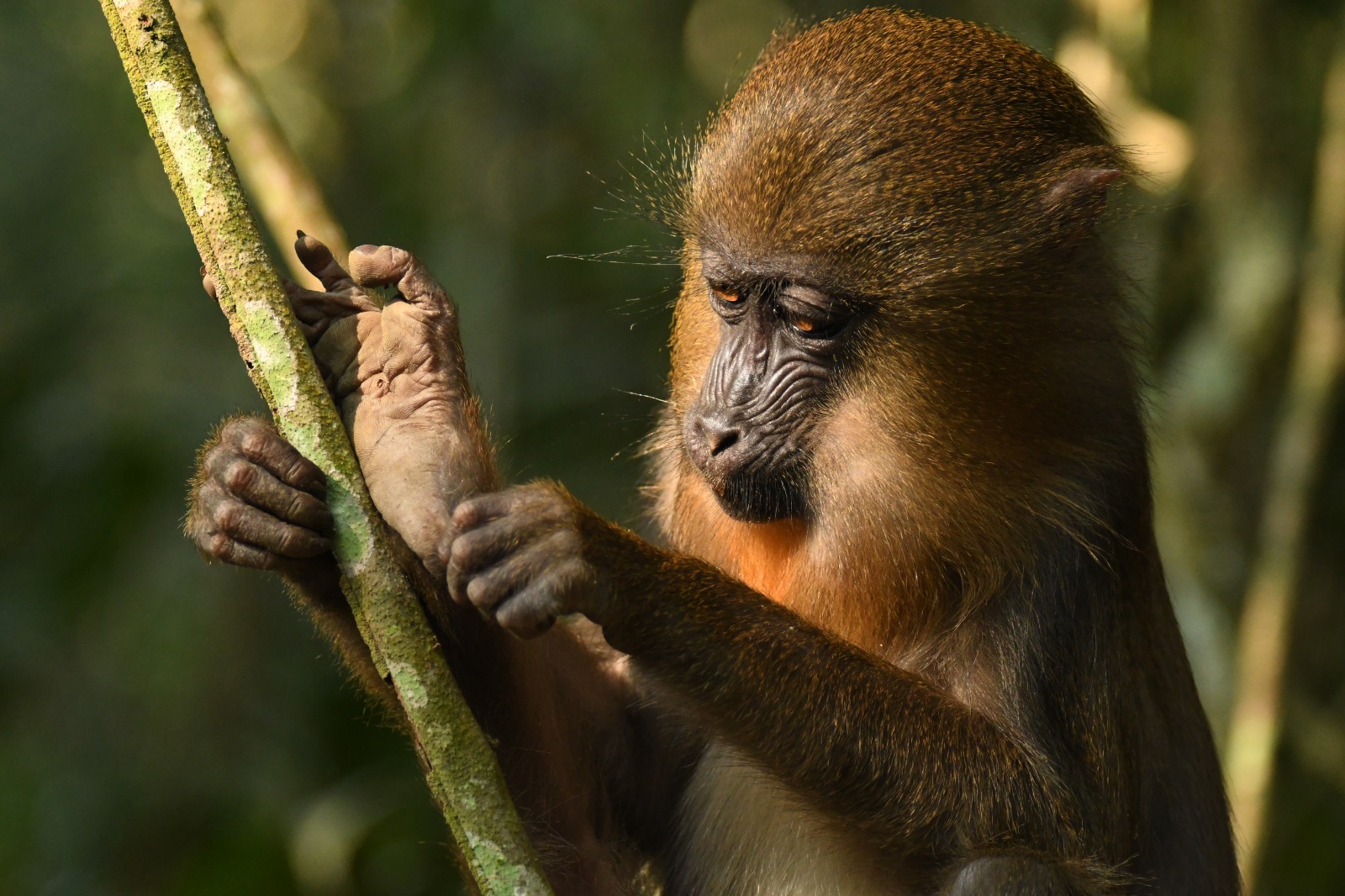
The Mandrillus Project
The Mandrillus project (www.projetmandrillus.com) is studying the socio-ecology of the only habituated population of wild mandrills...
Stillbirth of a mandrill (Mandrillus sphinx) in the wild: perinatal behaviors and delivery sequences
Birth is a fundamental event in the lives of animals, including our own...
85 documents
- Clémence Poirotte, Didier Basset, Eric Willaume, Fred Makaba, Peter M Kappeler, et al.. Environmental and individual determinants of parasite richness across seasons in a free-ranging population of Mandrills ( M andrillus sphinx). American Journal of Physical Anthropology, 2016, 159 (3), pp.442-456. ⟨10.1002/ajpa.22888⟩. ⟨hal-02079717⟩
- Clémence Poirotte, Peter M Kappeler, Barthélémy Ngoubangoye, Stéphanie Bourgeois, Maick Moussodji, et al.. Morbid attraction to leopard urine in Toxoplasma-infected chimpanzees. Current Biology, 2016, 26 (3), pp.R98-R99. ⟨10.1016/j.cub.2015.12.020⟩. ⟨hal-02079718⟩
- Marie Charpentier, Guillaume Odonne, Benoist Schaal. Chapter 3. Scents in the social life of non-human and human primates. Chemical Ecology, 1ère ed., ISTE Ltd, 238 p., 2016, Ecological Science Series, 978-1-119-33048-6. ⟨10.1002/9781119329695.ch3⟩. ⟨hal-01512016⟩
- Timo Brockmeyer, Peter M Kappeler, Eric Willaume, Laure Benoit, Sylvère Mboumba, et al.. Social organization and space use of a wild mandrill ( Mandrillus sphinx ) group. American Journal of Primatology, 2015, 77 (10), pp.1036-1048. ⟨10.1002/ajp.22439⟩. ⟨hal-02079709⟩
- Florence Levréro, Greta Carrete-Vega, Anaïs Herbert, I Lawabi, Alexandre Courtiol, et al.. Social shaping of voices does not impair phenotype matching of kinship in mandrills.. Nature Communications, 2014, 6 (1), pp.7609. ⟨10.1038/ncomms8609⟩. ⟨hal-01306666⟩
- M. Beaulieu, S. Mboumba, E. Willaume, M. Kappeler, M. Charpentier. The oxidative cost of unstable social dominance. Journal of Experimental Biology, 2014, 217 (15), pp.2629-2632. ⟨10.1242/jeb.104851⟩. ⟨hal-02079696⟩
- Jordi Galbany, Alejandro Romero, Mercedes Mayo-Alesón, Fiacre Itsoma, Beatriz Gamarra, et al.. Age-Related Tooth Wear Differs between Forest and Savanna Primates. PLoS ONE, 2014, 9 (4), pp.e94938. ⟨10.1371/journal.pone.0094938⟩. ⟨hal-02079706⟩
- Marie Charpentier, Christine Drea. Victims of Infanticide and Conspecific Bite Wounding in a Female-Dominant Primate: A Long-Term Study. PLoS ONE, 2013, 8 (12), pp.e82830. ⟨10.1371/journal.pone.0082830⟩. ⟨hal-02079677⟩
- Marie Charpentier, Sylvère Mboumba, Claude Ditsoga, Christine Drea. Nasopalatine Ducts and Flehmen Behavior in the Mandrill: Reevaluating Olfactory Communication in Old World Primates. American Journal of Primatology, 2013, 75 (7), pp.703-714. ⟨10.1002/ajp.22146⟩. ⟨hal-02079642⟩
- Elise Huchard, Marie Charpentier, Harry Marshall, Andrew King, Leslie Knapp, et al.. Paternal effects on access to resources in a promiscuous primate society. Behavioral Ecology, 2013, 24 (1), pp.229-236. ⟨10.1093/beheco/ars158⟩. ⟨hal-02079637⟩
Documents retrieved from the HAL open archive 
Follow Me On
Contact Info
Specialty
Mandrills, Primatology, Sociality