Marie Charpentier
Research Director
I work on the evolution of sociality in primate societies using long-term, individual-centered data. Since 2012, I have been running a field station in southern Gabon (Parc de la Lékédi, Bakoumba) to study the world's only natural population of habituated mandrills. In this population, I study the main determinants of social relationships, such as kinship or individual parasite status, as well as the proximal factors that regulate these relationships.
The social microbiome: The missing mechanism mediating the sociality-fitness nexus?
In many social mammals, early social life and social integration in adulthood...
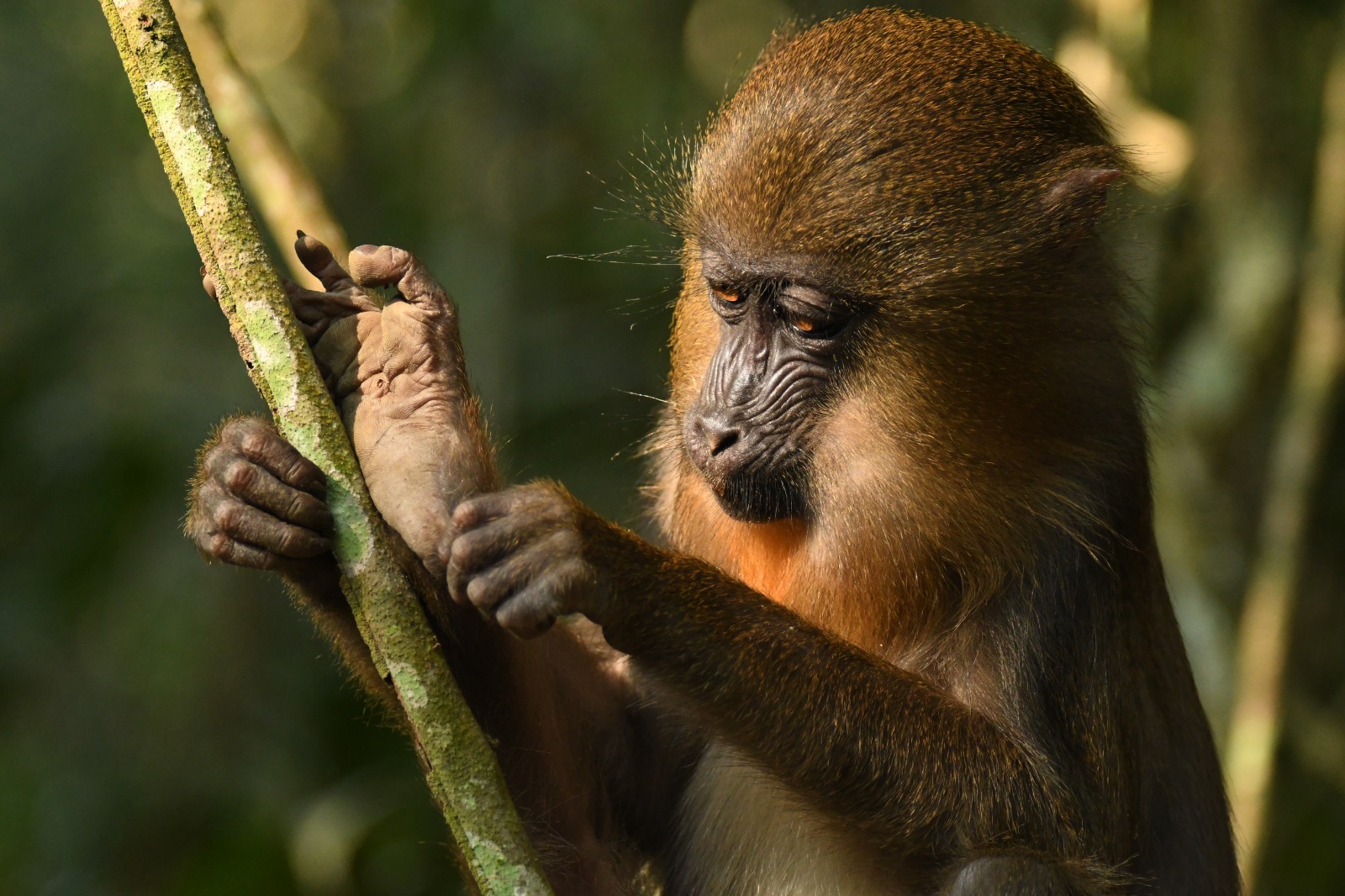
The Mandrillus Project
The Mandrillus project (www.projetmandrillus.com) is studying the socio-ecology of the only habituated population of wild mandrills...
Stillbirth of a mandrill (Mandrillus sphinx) in the wild: perinatal behaviors and delivery sequences
Birth is a fundamental event in the lives of animals, including our own...

86 documents
- Anne Starling, Marie J.E. Charpentier, Courtney Fitzpatrick, Elizabeth Scordato, Christine Drea. Seasonality, sociality, and reproduction: Long-term stressors of ring-tailed lemurs (Lemur catta). Hormones and Behavior, 2010, 57 (1), pp.76-85. ⟨10.1016/j.yhbeh.2009.09.016⟩. ⟨hal-02079605⟩
- Joanna Setchell, Marie Charpentier, Kristin Abbott, E. Jean Wickings, Leslie Knapp. Is Brightest Best? Testing the Hamilton-Zuk Hypothesis in Mandrills. International Journal of Primatology, 2009, 30 (6), pp.825-844. ⟨10.1007/s10764-009-9371-0⟩. ⟨hal-02079554⟩
- Elise Huchard, Julio Benavides, Joanna Setchell, Marie Charpentier, Alexandra Alvergne, et al.. Studying shape in sexual signals: the case of primate sexual swellings. Behavioral Ecology and Sociobiology, 2009, 63 (8), pp.1231-1242. ⟨10.1007/s00265-009-0748-z⟩. ⟨hal-02079550⟩
- Alexandra Alvergne, Elise Huchard, Damien Caillaud, Marie Charpentier, Joanna Setchell, et al.. Human Ability to Recognize Kin Visually Within Primates. International Journal of Primatology, 2009, 30 (1), pp.199-210. ⟨10.1007/s10764-009-9339-0⟩. ⟨hal-02079548⟩
- Marylène Boulet, Marie Je Charpentier, Christine Drea. Decoding an olfactory mechanism of kin recognition and inbreeding avoidance in a primate. BMC Evolutionary Biology, 2009, 9 (1), pp.281. ⟨10.1186/1471-2148-9-281⟩. ⟨hal-02079559⟩
- Marie Charpentier, Cathy Williams, Christine Drea. Inbreeding depression in ring-tailed lemurs (Lemur catta): genetic diversity predicts parasitism, immunocompetence, and survivorship. Conservation Genetics, 2008, 9 (6), pp.1605-1615. ⟨10.1007/s10592-007-9499-4⟩. ⟨hal-02079473⟩
- Steven Leigh, Joanna Setchell, Marie Charpentier, Leslie Knapp, E. Jean Wickings. Canine tooth size and fitness in male mandrills (Mandrillus sphinx). Journal of Human Evolution, 2008, 55 (1), pp.75-85. ⟨10.1016/j.jhevol.2008.01.001⟩. ⟨hal-02079466⟩
- Marie Charpentier, Marylène Boulet, Christine Drea. Smelling right: the scent of male lemurs advertises genetic quality and relatedness. Molecular Ecology, 2008, 17 (14), pp.3225-3233. ⟨10.1111/j.1365-294X.2008.03831.x⟩. ⟨hal-02079494⟩
- Owen R. Jones, Jean-Michel Gaillard, Shripad Tuljapurkar, Jussi S. Alho, Kenneth B. Armitage, et al.. Senescence rates are determined by ranking on the fast–slow life-history continuum. Ecology Letters, 2008, 11 (7), pp.664-673. ⟨10.1111/j.1461-0248.2008.01187.x⟩. ⟨hal-00318567⟩
- Marie Charpentier, Delphine Deubel, Patricia Peignot. Relatedness and Social Behaviors in Cercopithecus solatus. International Journal of Primatology, 2008, 29 (2), pp.487-495. ⟨10.1007/s10764-008-9246-9⟩. ⟨hal-02079468⟩
Documents retrieved from the HAL open archive 
Follow Me On
Contact Info
Specialty
Mandrills, Primatology, Sociality